
Georgi Tsaklev
Programmer struggling with artWeek of Reflection - Reflective Domains
Development Practice
Published on February 26, 2021
The topic of reflection is a recurring one in this course. Its value was made clear from the start and its importance for the success of each student's goals is reinforced every single week.
Spark Forum
The forum discussion topic was about employing reflection in three different situations - past (on-action), present (in-action) and future (for-action). In particular, we were asked to reflect on why we joined the course, what critical incidents we are experiencing during it, and how this affects our outlook for the future. This topic surfaced the similarities between many of the students in the course. While coming from different backgrounds, it is easy for everybody to "go with the flow" and progress their career into a direction they didn't intend to.
Time management is the most common impediment among the students who posted on the forum. This is also the problem I am struggling with the most. This has prompted me to consider arranging a reduced working hours schedule with my employer to give me the additional time I need.
Reading through the replies of my peers and realising I am not alone in my struggles was encouraging. This course has highlighted the importance of peers in one's development. I aspire to be an indie developer, which means I will not have thousands of employees for peers. Instead, I will need to learn to reach out online to forums and communities to find other indie game developers who will share the same struggles.
Reflective Domains
The five reflective domains are Dispositional, Affective, Interpersonal, Cognitive and Procedural (Parker, 2021). Each of them focuses on a different area of practice.
- Dispositional domain - Focus on time management, motivation, behaviour and discipline
- Affective domain - Focus on personal feelings, experiences and emotions
- Interpersonal domain - Focus on interaction with others
- Cognitive domain - Focus on one's approach to learning
- Procedural domain - Focus on assessing one's skills and finding where improvements are needed
This separation into domains is really useful as it ensures the reflection is balanced and all aspects are considered. I will be referring back to this list to ensure I account for all five domains.
Reflective Summary
After extending my blog to allow for the reflective domains to be used for tags, I reviewed all posts for the course so far and tagged them with the appropriate domains. The following pie chart shows the number of posts with each of the reflective domain tags.
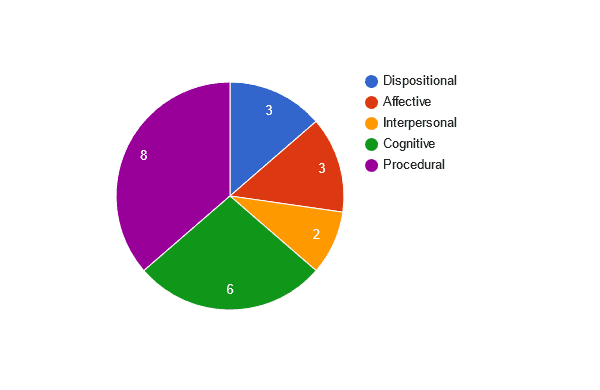
In my blog posts, the predominant domains of reflection are procedural and cognitive. The interpersonal domain is the least common in my posts, which is expected since all coursework so far has been individual and I could only reflect based on my research or previous experiences. The dispositional domain appears in a small number of posts. This is positive since the limited time I have for my studies, has not been as significant an impediment as I originally perceived. Lastly, the affective domain appears fewer times because reflecting on one's feelings and emotions less important for the overall goal. Instead, the focus is on skills and actions, and how everything learned can be applied in the future.
I think the spread of reflection domains in my blog posts is normal and there is no need for a significant effort to balance the domains further. However, I plan on using the reflective domains as a framework to structure my future reflections, which in turn can increase the usage of less common domains.
SMART Goals
I have identified the following SMART goals to guide me in my development in the near future.
| Goal | Goal 1 | Goal 2 |
|---|---|---|
| Origin Post | Rapid Ideation Session 1 - Planning | Reverse Engineering and Prototyping Challenge |
| Specific | Use ICEDIP technique in Rapid Ideation 2 | Focus on game design in Rapid Ideation 2 |
| Measurable | Reflect on my use of the ICEDIP technique after Rapid Ideation 2 | My ideation process should be focused on game design, mechanics and player interaction |
| Achievable | Rapid Ideation 2 is part of the course and starts one week after the first one finishes | To make this achievable I will focus this goal only on Rapid Ideation 2 |
| Relevant | Utilising the ICEDIP technique will help me structure my ideation process and achieve a more fleshed out idea before comensing with the prototyping |
Game Design is a topic I find great interest in, but lack practice. It would be essential to gain more skills in order to start my own studio. |
| Timely | Rapid Ideation 2 start on March 10th, however, I will reflect on the session after it completes on March 24th | Rapid Ideation 2 start on March 10th, however, I will reflect on the session after it completes on March 24th |
References
Parker, A., 2021. Week 5: The Five Reflective Domains. [online] Falmouth Flex. Available at: https://flex.falmouth.ac.uk/courses/911/pages/week-5-the-five-reflective-domains?module_item_id=49171 [Accessed 26 February 2021].
If you like it, share it!