
Georgi Tsaklev
Programmer struggling with artRapid Ideation Session 1 - Planning
Development Practice
Published on February 19, 2021
Goals
The first Rapid Ideation activity started with the reveal of the theme during the weekly webinar. I didn't want to start working before setting some objectives for the two weeks of ideation and prototyping. To aid my career aspirations, I've set the following SMART goals to ensure I gain as much as possible from the session (Conzemius and O'Neill, 2009).
| Goal | Goal 1 | Goal 2 | Goal 3 |
|---|---|---|---|
| Specific | Gain experience with Unreal Engine | Improve in areas other than programming | Work on "the end" of a game |
| Measurable | The final prototype should be built using Unreal Engine | Use the !Coding diversifier and don't write any code | The final prototype should be of the ending of a game rather than the first level |
| Achievable | The engine is free to use and has a lot of training resources online | Unreal Engine has a very powerful visual scripting language called Blueprint | The theme is very generic so I need to focus on what would be the experience at the end of the game instead of the start |
| Relevant | Knowing more than one game engine is essential for my career aspirations of having my own studio as it would remove this restriction |
Indie game developers have to wear a lot of hats. This goal will improve my skills in areas I am not as proficient in | So far all of my game prototypes encompass the start initial levels of games, where the player is introduced to the mechanics. It is important to gain experience for developing other parts of games. |
| Timely | To be achieved over the two weeks of Rapid Ideation Session 1 | ||
Theme
The theme for this rapid ideation session is comprised of two parts - a random Dixit card and a news article title of our choice. The Dixit card drawn was of a humanoid with wings and a mask, holding a balance scale and a scythe.

For the news article title, I decided to take something relevant to gaming so I eventually landed on "Warner Bros. roils game industry with patent on Nemesis gameplay mechanic by Kirkland’s Monolith" by GeekWire.
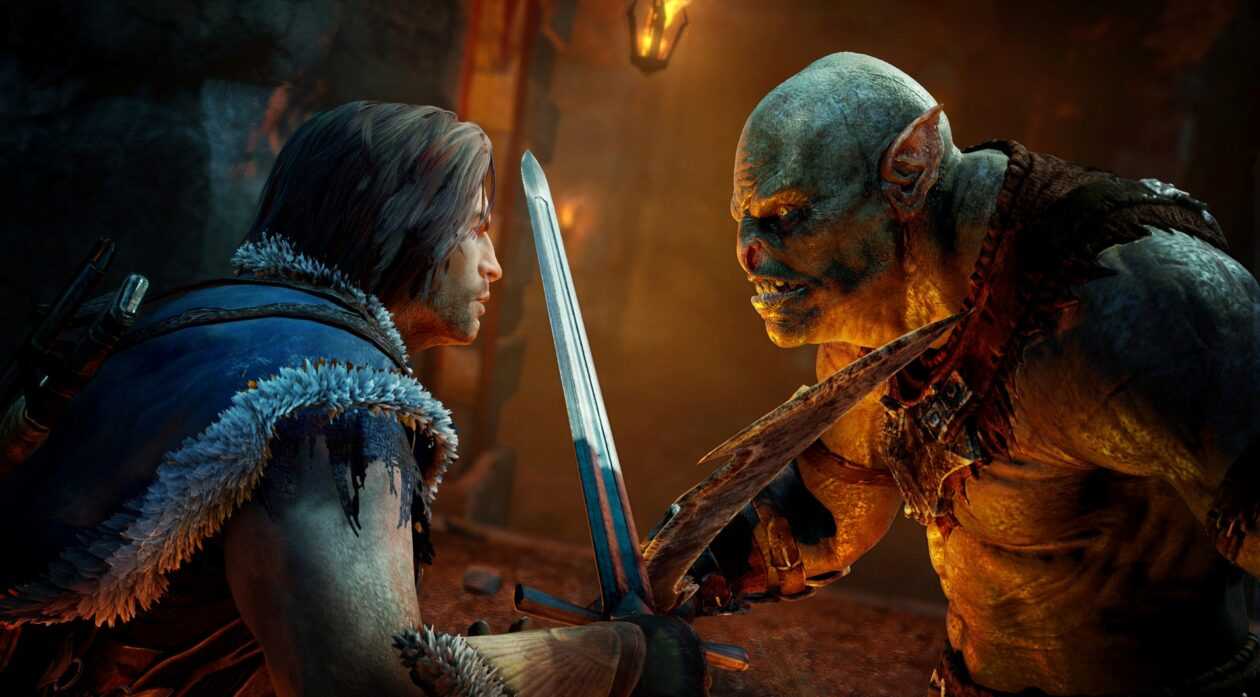
I thought the controversial nature of the decision from Warner Brothers would work well with the mixed angelic/demonic appearance of the character in the Dixit card.
Ideation
For the Rapid Ideation process, I started with a Mind Map. This time I placed three things in the centre - the image, the article title and the words "End of a game" in order to direct myself towards achieving my third goal.
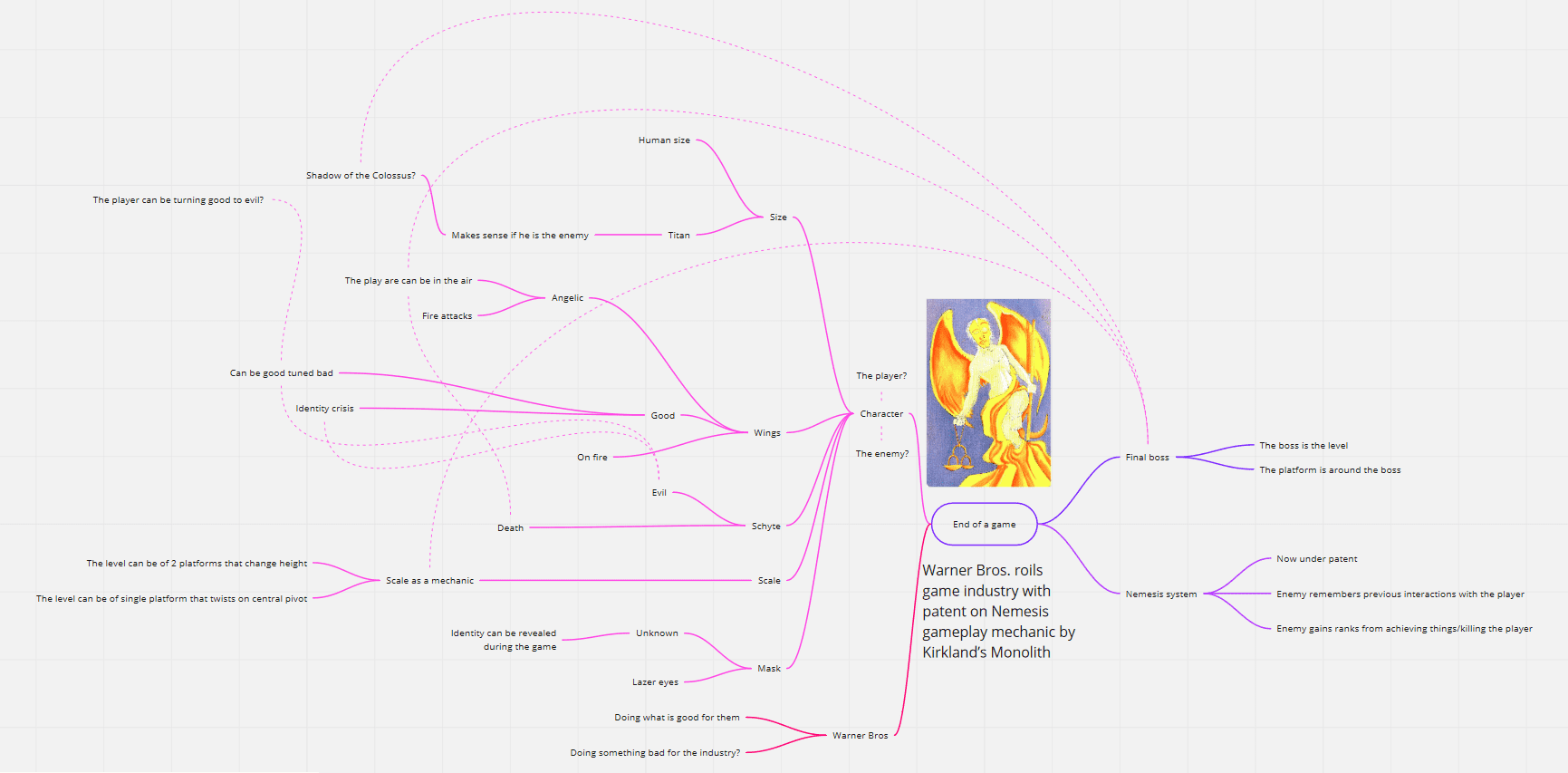
Initially, I started looking at the character in the card, describing their features and use them as a basis for game mechanics. This was my largest section and the aspects of this character represent powerful themes such as the idea of death and their scythe, their angelic nature and their fiery wings. This prompted me to think about the size of the character relative to the player and led me to the idea that the character would make a good final boss as a titan. Immediately I thought of Shadow of the Colossus, a game where the player is fighting gigantic Colossi which are the true levels in the game, so I figured I would love to try and create something similar.
From the article title, I branched two key points - the Nemesis system, and Warner Brothers and their actions. These points I used during the brainstorming of the story and "why" the player would be in the situation they are in. In retrospect, I should have tied them together more, however, during the second brainstorming, I focused on reducing the scope, trimming down my ideas as I go, to ensure I would not spend excessive amounts of time during development.
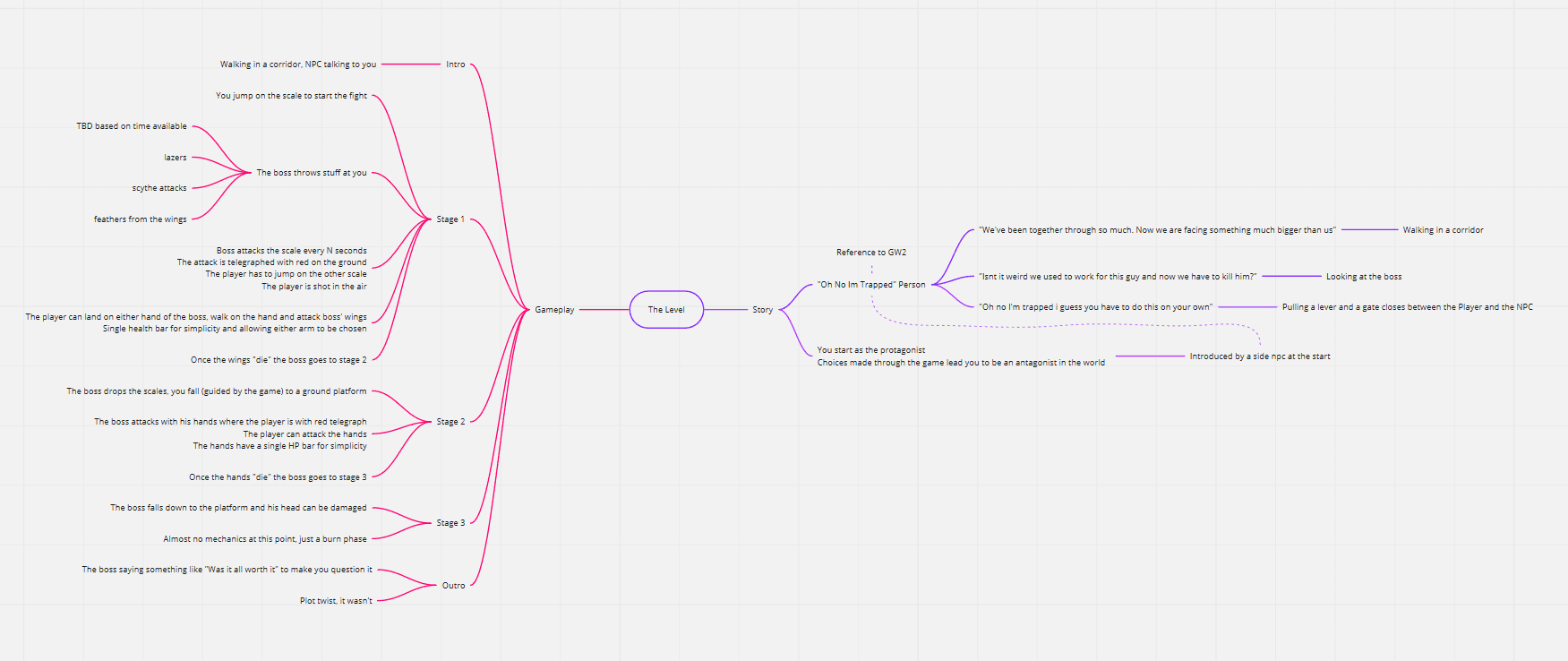
After I finished with the first brainstorming session, I moved on to the level itself, focusing on two areas - story and gameplay. I first looked at the story, trying to make it meaningful for the player by providing some context. This section is very streamlined, however, the general feel I was going for was a combination of tragedy and comedy.
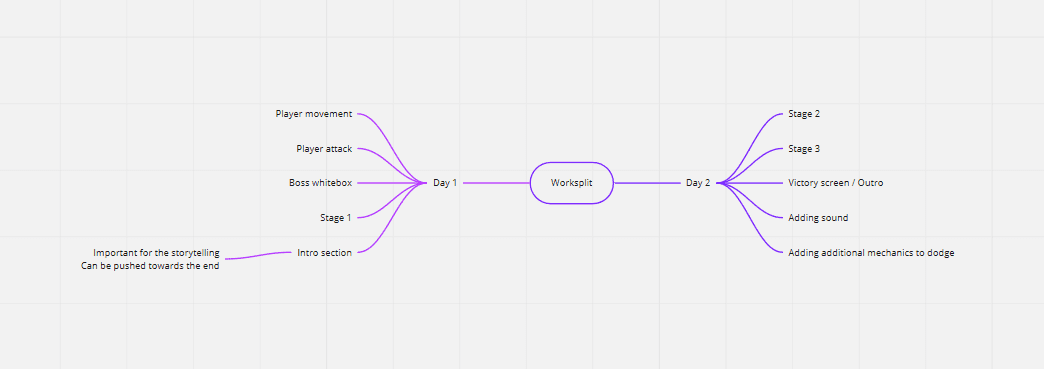
For the gameplay, I focused on the flow of the fight with the boss, the main mechanics of the fight and how the player would interact with them. This flow led to a nice separation of the fight into stages and allowed me to divide the work over two days so I could focus and not burnout during the prototyping.
In retrospect
The ideation process took me about 3 hours to complete and since we have two weeks for the prototype, I consider this to be a reasonable commitment. Additionally, I limited the scope due to the time constraint during the brainstorming, however, it would be useful to have a record of all ideas. In future ideation sessions, I should focus on using the ICEDIP technique, which separates the ideation from the trimming down to the scope and would solve this issue.
References
Conzemius, A. and O'Neill, J., 2009. The power of SMART goals: Using goals to improve student learning. Solution Tree Press.
Miro. 2021. Miro. [Software]
If you like it, share it!